As James Justin sat at Thorp Arch and listened to anti-racism poetry, he felt like he could relate.
Three teenage Seacroft girls called Rita, Maimuna and Praise originally wrote the poem for a competition. They performed it at Leeds United's training ground on a school visit as part of the Premier League's No Room For Racism campaign and the club's participation in Black History Month.
The piece is entitled 'We Carry More' and lays bare the girls' shared experiences of growing up while having to deal with discrimination.
"Before they hear my voice, before they learn my name, they see my skin," it begins. "Suddenly a whole story appears in their minds that I never wrote. They decide I am loud before I speak. They decide I am angry before I feel anything. If I speak strongly it’s called ‘attitude.' If someone else does the same, it’s called ‘confidence. ' Funny how the same voice sounds different depending on who's listening.
"Sometimes discrimination is loud. A joke, a comment, a stare that lingers too long. But sometimes it’s quiet. Teachers expecting less. Stores watching closer. People acting surprised when we succeed - like brilliance was never meant to belong to us.
"They see our hair and call it ‘unprofessional.' They hear our voices and call it ‘too loud.' They see our strength and call it ‘too much.' But they never ask what it took to become this strong. They don’t see the history walking besides us, the generations who fought just for us to stand here, just for us to speak. Three black girls that refuse to disappear. Every insult, every stare, every moment someone expected less did not break us, it built us. Words - they’re more than that. We carry more."
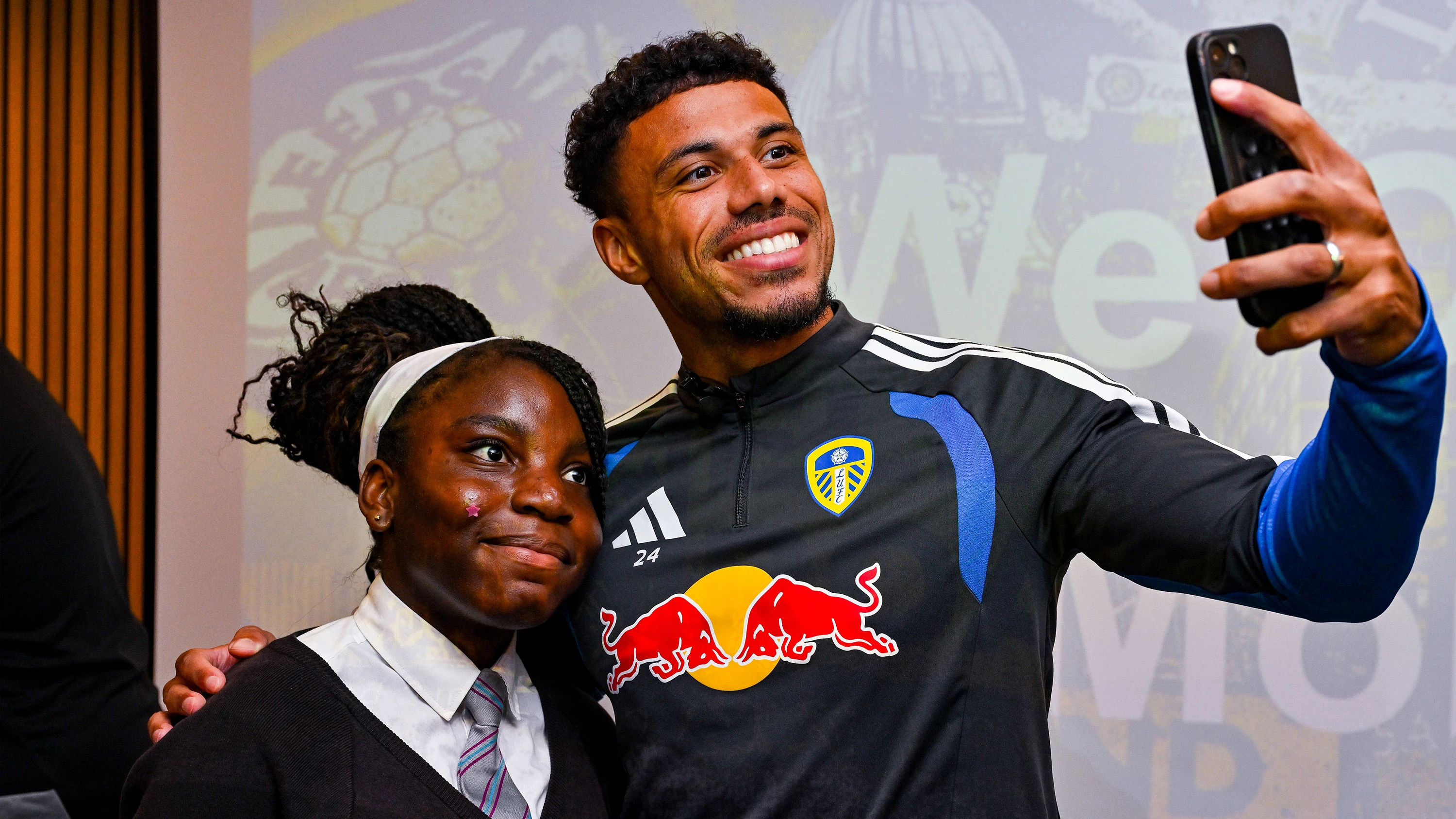
The performance formed part of a Black History Month workshop for Year 9 and 10 pupils from Bishop Young Academy in the east of the city. The students visited Leeds United's training ground for a tour of the facilities and a meeting with Justin and Noah Okafor. The first team players listened to a presentation on Leeds' first black player, Gerry Francis, and club ambassador Lucas Radebe before the poetry performance, a Q and A session and a chance for photos and autographs.
While Justin was signing school ties, one youngster asked Okafor if she could speak Igbo [a major Niger–Congo language] to him. The winger's response was to suggest her family could perhaps cook Nigerian food for him.
"It was really enjoyable to meet the girls and boys, and just for them to take us through the presentation on a couple of iconic Leeds black players and their roots and what they've been through," said Justin afterwards.
"I probably understand it a bit more in terms of the apartheid, obviously my dad went through some of the same things that that they went through. Growing up in London in the 80s was a difficult thing, especially being with my mum, a a white woman.
"There were definitely some scary, scary eyes looking at them, and people saying, 'No, this isn't right,' and stuff. I'm just glad we don't have to go through the calibre of things that they had to go through when they were growing up. For everything to be accepted more now is a great step in the right direction. It definitely makes this country better, especially having all of the cultures and backgrounds coming together, and football is a great place to do it as well because everyone's equal when they get on the pitch. We're striving for equality off the pitch as well."
Justin heard themes in We Carry More that he could relate to his own childhood.
"I would say so - what was different for me was that a lot of them are full black, and being half black myself is a little bit different - but there was still the stereotype when I was growing up, of what they're speaking about in a really good poem," he said.
"We've come a lot of years since I was in their shoes but there's still a long way to go. For me growing up was quite easy in school and with the parents I had because I didn't take much notice of what other people thought of me. Obviously, everyone's not like that. Everyone doesn't have the great parents that I had, so school is the biggest area where we can work on things and instill the fact that everyone's equal. That's the best place to do it.
"I feel like it will take some some time, definitely. You still get these things - if they speak up, they're being like rude but if someone else speaks up, they're being confident. It's just trying to make that a thing of the past, really. And that's what this month is great for, bringing the awareness that everyone wants to be treated equally and and we don't want discriminatory thoughts coming into people's heads anymore."
Where Justin finds hope is in his ability to replicate the parenting he experienced, which negated the impact of others' opinions, and the work being done in schools to teach tolerance.
"I wouldn't say [it plays on my mind as a dad] because I'm confident in the principles that I can instill in my kids," he said. "That, and my oldest is three, and he's got to the stage of 'why are they doing this? Why are they doing that?' but he doesn't ever ask me anything about people's colour. It starts from the parents and then when you get into school, to teach kids that everyone is equal. Everyone comes from different cultures and backgrounds, and that's okay. You come from your own, and you can be proud of that as well."
Football is another vehicle for promoting inclusion. Justin has shared dressing rooms with what he calls an 'endless' list of cultures and backgrounds.
"Each one of them is different in their own way, and brings something new to the table, whether it be Noah's Nigerian background, and I played with Nigerians in the past, whether it be some of the French players that I played with, their African descents, and Caribbean people and Asian minorities in football," he said.
"They each bring their own cultures and backgrounds and ideas into the mix. And football, as I said, is the best place to do it because as soon as you get on the pitch, everyone's thought of by the way they play football, not the way they look or their cultural differences, and so that's obviously why we're striving so much for it in football."
Justin and Okafor's participation in the workshop left an impression on the students and the staff members who accompanied them. The school's Head of Pastoral Care Cara Mahoney said: "The Black History Month workshop itself was a fantastic experience, made even more memorable by meeting Noah Okafor and James Justin. For our students to have the opportunity to showcase their oracy skills, share their ideas and demonstrate their passion for equality and inclusion, regardless of race or background, was a hugely proud moment.
"Both Noah and James were incredibly engaging and had a positive impact on every student involved. Their openness and willingness to speak with the students made the experience even more special and created memories that will stay with them for a very long time. It was a truly inspirational day and an opportunity of a lifetime. One that both staff and students will never forget."
Andy Wormald is the Leeds United Foundation's Education Supervisor. He added his appreciation for the players' willingness to get involved. "The students from Bishop Young Academy, who are part of our Secondary School Hub programme, did a fantastic job with their presentation and the poem. Noah and James were fantastic with the students, signing autographs and even giving two lucky students match worn shirts signed by Noah himself."
For Justin it was both a responsibility and a privilege. "To be honest, I'm not one to shy away from most topics and educating the youth is obviously a big thing," he said.
"I understand how hard it can be to come from different backgrounds and and have different challenges. I just want to help them as much as I can and obviously we know the power that we have in this position and we want to use it in the right way and try and educate them to the best of our abilities.
"We're these high-profile people, but when you get to know us, we've been through similar things that they've been through or going through, and I feel like it makes such a difference. I remember when I was a kid, for your team's annual presentation you might get like a guest from a local side, and we had someone from from Luton. His name was Leon Barnett, and I remember him coming in and shaking our hands and giving out the awards. But it was like a massive thing for us as kids because we we've seen him play and obviously it gives you something to look to and and strive for."