"Frank would have loved this, he would have thought it's fantastic."
Dave Worthington is a proud big brother. He and the family's second son Bob are standing in a crowd of dozens outside the terraced house where they and their baby brother were all born.
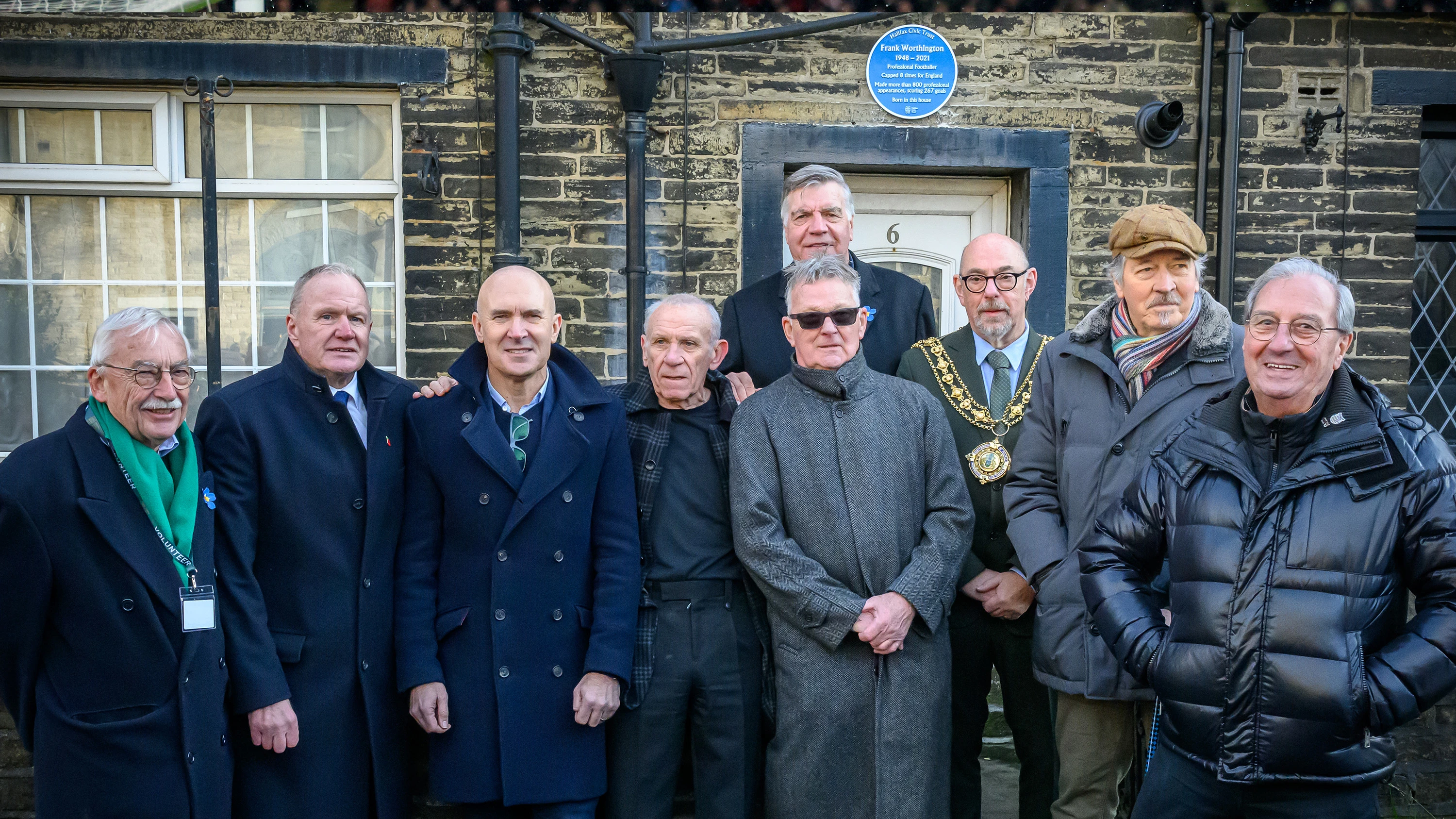
Dotted around the top end of West Street in the village of Shelf are familiar faces, including Eddie Gray, Tony Dorigo, Sam Allardyce, Peter Reid and John McGinlay. Councillor Andrew Tagg and a host of representatives of the extended Worthington family mingle with Halifax Civic Trust members and supporters of football clubs. Some have travelled to Halifax from Leicester. They are all there to see the unveiling of a blue plaque for the late Frank Worthington on their former family home.
"It's fantastic to see this," said Dave. "We knew a certain amount were coming because our family's quite a big one. There's some some people that lived in the village with us back in those days, in the 1950s and early 60s, because we lived in this house till I was 11 years old. Bob came along two years later, and then Frank came along 18 months later. But we have a sister as well, Julie. So when Mum was pregnant with her, this was only one bedroom, no toilet - toilets around the back of the house - we moved to a council house with three bedrooms. So we've always been grateful that my sister arrived."
From such humble beginnings grew somewhat of a football dynasty. Dave made more than 500 Football League appearances, the majority of which came at Grimsby Town. He was then a scout for various Premier League clubs, working in Spain. Bob was a full-back who played more than 230 times for Notts County. And Frank's 25-year career took him to numerous clubs, including Huddersfield Town, Leicester, Bolton Wanderers, Birmingham City, Southampton and Leeds United. He was a goalscorer and a maverick.
"Everywhere you went, someone knew and loved Frank, because he was an artist," said Dave. "He was a football artist. He had so much quality in him and he scored goals as well. He was unbelievable. He was a good character too, he loved talking to the fans. When we went out people were always just coming up to him and he'd chat with everybody. He was a bit like me, a chatterbox. But a great lad. He would have loved this, he would have thought it was fantastic."
Frank died in March 2021, aged 72, after living with dementia for a number of years. When Halifax Civic Trust raised funds for his blue plaque, additional funds were given to the Alzheimer's Society's Sport United Against Dementia fund, to support current and former players, staff and fans across the UK affected by the disease. Representatives of the Alzheimer's Society are in Shelf to see the unveiling.
Before the mayor performs the honours, Halifax Civic Trust chair Alan Goodrum thanks the assembled crowd for turning out on what would have been Frank's 78th birthday. Goodrum says one of the Trust's key objectives is 'conserving heritage in Halifax and celebrating successes of our favourite sons and daughters and Frank is very much one of those. A well known character and it's wonderful to have this plaque here to put Halifax on the map.'
John Peters, volunteer and committee member for the Trust, reads out messages of support including one from Gary Lineker. "Frank was my hero growing up," he said. "He was always generous and kind to me as a 16-year-old apprentice."
Inevitably there are references to the goal Frank scored in 1979 against Ipswich Town, when he juggled the ball and flicked it over Terry Butcher's head before firing home. One of his team-mates at Bolton was ex-Leeds boss Allardyce.
"I played with Frank twice," he said. "I played with him at Bolton, that was the best time. Ian Greaves brought him in and he helped us win promotion, he scored the winning goal at Blackburn to clinch it. And then, of course, he won the [First Division 1978/79] Golden Boot the year after, of course, and known him ever since really.
"I got to play with him at Preston. He lost his job as manager of Tranmere, and John McGrath brought him in to help us win promotion. Frank could play anywhere, he'd play in any division as long as he kept playing. I think he was 40 then, maybe 41. But his skills never left him, his talent never left him, and of course his personality never left him. So it was great to be with him twice. I think we could do with a bit more of his talent and personality in the game now."
With the plaque unveiled and photos taken, the party moved across the street to the Duke of York pub for a storytelling session. Frank would have loved that too.